
Array
(
)

MTA 3.2 is here: use your AI assistant to build Mendix tests faster

Build Mendix tests faster

A better way to build automated tests in Mendix

Announcing the general availability of Menditect Test Automation 3.2

Today, we are releasing Menditect Test Automation (MTA) version 3.2.

MTA has been helping Mendix teams run automated regression, functional, and integration tests for years. What makes it unique is its close integration with the Mendix runtime: it runs microflows directly, executes tests inside transactions, and automatically rolls back database changes so you don’t pollute your test environments.

With version 3.2, we’re addressing the biggest friction point in test automation: “how long it takes to set up tests in the first place.”

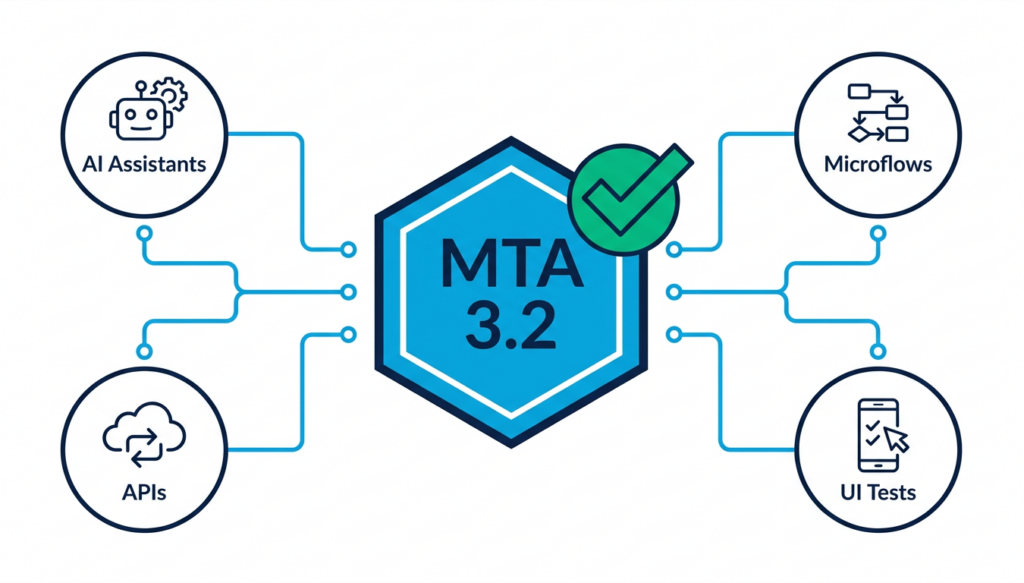
MTA 3.2 includes an official Model Context Protocol (MCP) server. This allows modern AI assistants (like Claude Code, Cursor, Gemini Antigravity, or GitHub Copilot) to inspect your Mendix project and set up test suites, steps, and assertions inside MTA for you.

Tackling the manual setup bottleneck

Making full regression coverage realistic for Mendix 9 and 10 apps

If you have ever set up test cases by hand in MTA 3.1, you know the process: open the web interface, add a test suite, pick your test steps, select the entity types, and fill in parameter values and assertions one by one.

It worked well, but it was slow.

For a large application built in Mendix 9 or 10 with dozens of business-critical microflows, setting up a proper regression suite could easily take weeks of tedious clicking. Most development teams simply didn’t have that time. Automated tests were put off, and test debt accumulated.

MTA 3.2 changes the equation:

  • The AI handles the setup: Instead of configuring every parameter by hand, you ask your AI assistant to analyze a microflow. It inspects the logic and calls MTA’s MCP tools to generate the test cases and variations for you.
  • All test levels in one tool: You can generate unit tests for calculation microflows, component tests for module logic, multi-step backend process tests, and web UI tests.
  • Built-in data seeding and cleanups: Tests can automatically create the test objects they need before running. MTA’s transactional rollbacks ensure no leftover records remain in your database.
  • Ground truth when docs are missing: If you have user stories or specs, feed them into your prompt. If documentation is outdated or absent (as is common in older applications), the AI inspects the compiled Mendix model (.mpr) directly to extract the real logic and decision splits.
  • Realistic safety nets for upgrades: Teams maintaining older Mendix 9 or 10 apps can now build a solid regression safety net in days, making migrations to Mendix 10 or 11 much safer.

What’s new in MTA 3.2

Practical tools for everyday Mendix development
  • Official MCP server: A clean set of tools that lets your AI assistant create test suites, test cases, parameters, assertions, and variation matrices inside MTA.
  • Agentic test skills on GitHub and Marketplace: Menditect does not only deliver MCP tools, but also ready-to-use agentic test skills via our public GitHub repository (Menditect/agentic-test-skills) and the Mendix Marketplace to guide your AI assistant with test design best practices.
  • Open source workspace configuration template: Menditect publishes ready-made workspace configurations for MTA MCP, MTA plugin MCP, and mxcli or Studio Pro MCP in the repository Menditect/agentic-test-workspace.
  • Bring your own AI: No proprietary AI chatbots or extra per-seat AI subscriptions. MTA connects to the AI assistant you already use in your IDE.
  • Safe model inspection (mxcli or Studio Pro MCP): The AI reads your application structure in a safe, read-only manner using mxcli, or via the native Studio Pro MCP server available in Mendix 11.12 and higher. It never alters your project model directly.
  • Low token overhead: Tools are designed specifically for Mendix concepts, keeping prompts concise and API costs down.

Sensible economics: build with AI once, run natively forever

Keeping your test pipeline fast and predictable

Running AI models on every commit in your CI/CD pipeline gets expensive and slow quickly.

MTA 3.2 separates test creation from test execution:

  1. AI for creation: You use AI once during development to inspect the model and create the test case in MTA. This takes minutes and costs pennies in API usage.
  2. MTA for execution: Once saved, your test cases run natively in MTA at compiled speed. You can run hundreds of automated regression checks on every build with “zero ongoing AI token costs.”

What this means for your team

  • For developers: Build thorough test suites for complex microflows in minutes without leaving your editor.
  • For testers: Set up repeatable tests across unit, process, and UI levels with built-in data seeding and rollbacks, without writing custom code.
  • For product owners and leads: A practical way to eliminate test debt on older Mendix 9 or 10 apps and de-risk major platform upgrades.

Mendix builds the future; Menditect ensures it works.

MTA 3.2 is coming out in a few weeks. If you want to see how it works on real Mendix microflows, check out these sessions:

See MTA in action:

Dick van Gorkum

Get in touch with Menditect

Fill out this form and we answer your question or help you out.

Menu